UPDATED – 05/10/2026
The Environment Agency, Port of Blyth, Northumberland County Council, and other partners are continuing to work together to respond to the ongoing pollution incident at Blyth Beach.
Laboratory testing has now confirmed that the substance identified on the beach is creosote. Our investigations indicate that the likely source of the pollution is a former timber treatment works that operated on land adjacent to the affected area of the beach until approximately 1980.
The Port of Blyth has appointed specialist consultants to support the next phase of the investigation, and good progress has been made in developing a detailed site investigation plan which will allow an agreed option for remediation to be developed and implemented.
Current restrictions remain in place, and we are continuing to advise the public to not enter the affected area and to follow instructions on signs at the beach. Although we are no longer in the official bathing water season, advice against bathing for the affected section of the beach (north of the Dave Stephens Centre) is still in place.
The Environment Agency has put in place a regular programme of seawater testing along Blyth South Beach. The first sample in this programme was collected last week. The results will help us monitor water quality and provide the evidence needed to support any future decisions about bathing water advice and restrictions on access to the beach.
We recognise that these restrictions continue to affect residents, visitors, and local businesses. The restrictions will remain under review as further evidence becomes available. Our priority remains protecting public health and the environment while investigations and plans for remediation progress.
For more information please visit: nland.cc/Blythpollution
UPDATED – 20/08/2026
The Environment Agency, Northumberland County Council and Port of Blyth are continuing to work together to understand the findings of an Environment Agency investigation into a pollution at Blyth Beach. This includes investigations into historic industrial land use in the area to help identify the potential source of the pollution.
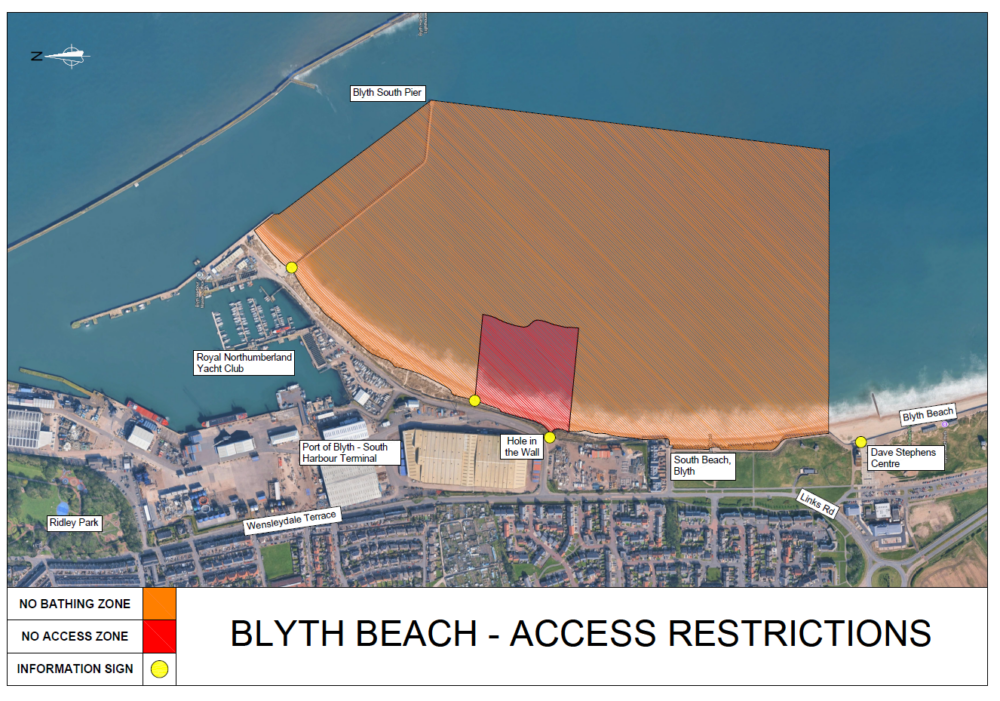
Preliminary analysis of samples taken by the Environment Agency suggest creosote contamination within the affected area and, as a precaution, restrictions are currently in place on both the land access and bathing in the affected area (north of the Dave Stephens Centre).
There is also a temporary restriction at the Hole in the Wall entrance to the beach to ensure the safety of visitors and the public while further analysis is ongoing. Initial water samples indicate that the bathing water site south of the Dave Stephens Centre remains unaffected.
We appreciate the impact these restrictions have on residents, visitors and local businesses and we will provide further updates as more information becomes available.
Members of the public are asked to follow all the signage and advice that is in place.
For further information, including a map of the restricted area, please visit: nland.cc/Blythpollution
Background information
The contamination is largely contained within the sand and any pollution that does reach the bathing water is expected to be heavily diluted by the sea.
13/08/2026
The Port of Blyth is aware of localised pollution at Blyth Beach and is liaising with the Environment Agency and Northumberland County Council in relation to the ongoing investigation.
A substance has been identified on the beach forming a sheen on water and sand, and as a precaution members of the public are being advised not to bathe in the affected area.
The cause and nature of the substance are currently being investigated. We will continue to support the relevant authorities and provide further information when it is available.